






Mare Termale Bolognese - English version
A historical overview: a brief history of Bologna spas
The earliest historical documentation regarding spas in Bologna comes from a lengthy inscription engraved on a stone plaque built into the walls of the courtyard of Palazzo Albergati. Another significant inscription, discovered in the suburban area of Bononia, dates from the third century AD. Thanks to these items, the following points can be considered facts:
- Emperor Augustus built a public spa in Bologna in the early first century AD. This spa was later restructured by another emperor of the Julius-Claudius line. Which emperor this was is unclear – it could have been Caligula or Nero as both were condemned to damnatio memoriae. The idea of it having been Nero is plausible, as he was particularly interested in Bononia.
- In the second century AD, a wealthy Bologna resident Tito Aviasio Servando, left in his will a large sum of money (400,000 sesterces) for his son Seneca to be used to allow free access to the Augustinian spa for both adults and children of both sexes.
- An inscription, which today would be considered an advertisement, exists from the third century AD by Caio Legianno, stating that his suburban spa offered the same facilities and standards of comfort as could be found in the city spa.
Bologna's spas therefore have a history, albeit of alternating fortunes, spanning over 20 centuries.
During the late 19th and early 20th century, the Corticella spa was operational and later the Casaglia spa opened. Bologna's late 20th century spa scene was dominated by the Terme Felsinee centre, whilst the Terme San Luca and San Petronio spa centres were inaugurated at the start of the 21st century. While the 19th and 20th century spas focused mainly on inhalation treatments, it is interesting to note that today’s third generation spas have brought back the Roman spa culture philosophy, based on spa water bathing.
The organisation of Roman spas and the spas of today in Bologna compared
Roman spas had a complex structure. The facilities which provided water at various temperatures were central: the caldarium which contained the alveus (a basin of hot water) and the labrum (a cold water source), whilst the toughest clients could make use of the frigidarium, a pool of totally cold water. Around this central area was the section dedicated to body care - massages and use of lotions in particular. The variety of activities offered by the sports area was notable – ball games and hoops, combat, boxing, fencing and so on.
For the Romans, the social aspect was important. Everything was discussed at the spa, from financial dealings to emotional ones. Also, if necessary, medical intervention is possible at the spa.
From a functional point of view, the main differences between the spa centres of Bologna today and those in Roman times are down to technical progress. One thing is certain: the spa circuit which goes from warm water to cold continues to be central to today's spas, just as the body care aspect continues to be fundamental (nowadays referred to in terms of beauty farm spas). The sports side of things has changed a great deal – physical training takes place in gyms, with sophisticated equipment such as those made by Technogym. The socialisation aspect has changed in line with the lifestyle, so that rather than being a constant feature as it was in Roman times it is now more limited to spare time during the evenings.
Lastly, whilst Roman spas had various features aimed at socialisation (refreshment areas, sports facilities, libraries and so on) alongside the purely spa-based aspect, today's spas have concentrated on developing the medical side of things. There are specialised clinics and diagnostic facilities (CAT, MRI, ultrasound etc) as well as rehabilitation and other facilities.
Prevention and health, a story that goes back two thousand years
The Romans saw their spas as a place for disease prevention and health in the most complete sense of the word, before being a place for relaxation, socialisation and sport. This can be seen in the so-called spa water circuit present in every Roman spa complex. It was known in Roman times that a gradual passage from cold to hot and viceversa is beneficial to the body in ways which nowadays we are able to explain through science – back then it was just understood through practice. Today we know that the Kneipp method based on the hot-cold idea stimulates vasodilation and vasoconstriction. It also tones the cardio-circulatory system and has preventative effects against arteriosclerosis, aging, arthrosis, heart attacks and strokes. Bearing in mind the fact that 70% of diseases are linked to the cardio-circulatory system, the significance of the Kneipp method in terms of prevention and health is clear. The Romans used the method in their spa circuit rituals. The Mare Termale Bolognese spas of today make use of it with global artero-venous (AVG) techniques as a kind of vascular exercise. Terminology changes, as do techniques but the aims and objectives have remained the same, despite the fact that over 2,000 years divide the Augustinian spas and those of today.
All of these reflections point to the fact of Bologna being Italy's spa capital, it being the only large city boasting as many as three spa centres.
Mare Termale Bolognese: today
During the years following the recognition of the Terme Felsinee waters as therapeutic in 1995, several new spa centres were opened.
Terme Felsinee
The Terme Felsinee spa centre, the first of the Mare Termale Bolognese spas, uses two types of spa water (bicarbonate-sulphate-calcic and sulphureous).
Terme Felsinee offers spa baths, wellness packages, water-based courses for all requirements (from basic fitness to functional rehabilitation), inhalation and respiratory cures, as well as specialised health-care and physiotherapy.
Terme San Petronio - Antalgik - Bodi
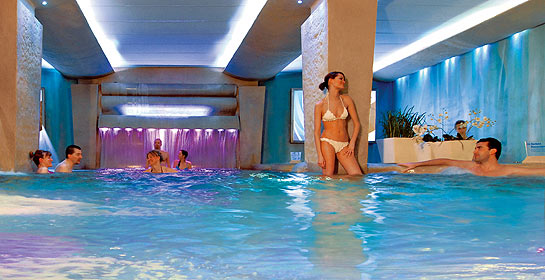
With a convenient central location, this spa centre is ideal for time-out in the water and for beauty treatments. The same bicarbonate-sulphate-calcic spa water is used from the “Alexander” spring as at the Terme Felsinee, thanks to 5km-long thermal pipes which pass through canals that were used by silk-works during the Renaissance.
Diagnostic and specialised healthcare is provided by the Antalgik outpatients clinic which has major health-care facilities and completes and integrates the services offered by Terme San Petronio. The services are run in respect of the World Health Organisation's definition, which describes health as “a state of complete physical, psychological and social wellbeing, and not simply the absence of disease”.
Newly opened this year, BODI is a diagnostic pole of excellence with facilities for CAT scans, open and closed MRI with or without contrast material, digital mammograms, digital radiography, densitometry, ultrasound scans and so on – a real concentration of technology all in one place.
Terme San Luca - Pluricenter
A historic “temple of fitness” dating back over 25 years, Pluricenter is now even bigger and more comprehensive, thanks to spa-water swimming pools - an ideal spa-wellness centre with integrated facilities.
The rich bicarbonate-sulphate-calcic spa water, which incorporates 18 trace elements, widens Bologna's spa tradition and brings it into the new millennium in a pleasant and varied environment that invites exploration.
Fitness, wellness and rehabilitation both in the gym and in the spa-water pools, Terme San Luca has it all.
Terme Acquabios
The individual character of the Acquabios spa centre – the newest of the Mare Termale Bolognese spa centres - is down to its personal and personalised approached.
The centre moved into new 1500sq.m premises in 2009, opening up a hydrotherapy area which also uses the Terme Felsinee spa water. Certification procedures are underway to recognise the properties of the centre's own spa water source.
Acquabios is a point of pride for the Bologna area in the field of wellness, treatments and functional rehabilitation.

Villaggio della Salute Più - Terme dell'Agriturismo
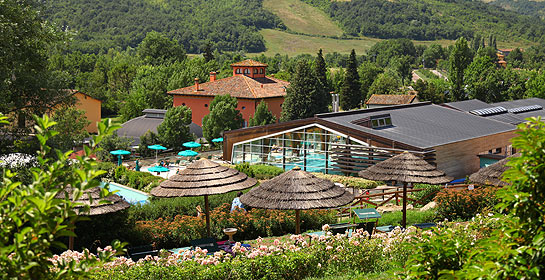
Villaggio della Salute Più is located in the Sillaro river valley in the foothills of the Apennines, just outside Bologna. As a centre it is one of a kind, aimed at health, wellness and relaxation for all ages, all year round. The Terme dell'Agriturismo spa is open all year, whilst the Salute Più Acquapark is open from May to September. There is also the agriturismo, a working farm offering accommodation and restaurant facilities – altogether the services offered by Villaggio are many and varied.
Terme S.Petronio Antalgik
Terme S.Luca Pluricenter
Terme Felsinee
Villaggio della Salute Più
Terme Acquabios